- - - - -
"Steampunk is what happens when Goths discover brown,"
You guessed it just by the quote what the topic of disscussion is for today, folks. That old new wave craze that's sweeping up fans faster then Dorothy's house in a tornado.
That's right, I'm talking about Steampunk.
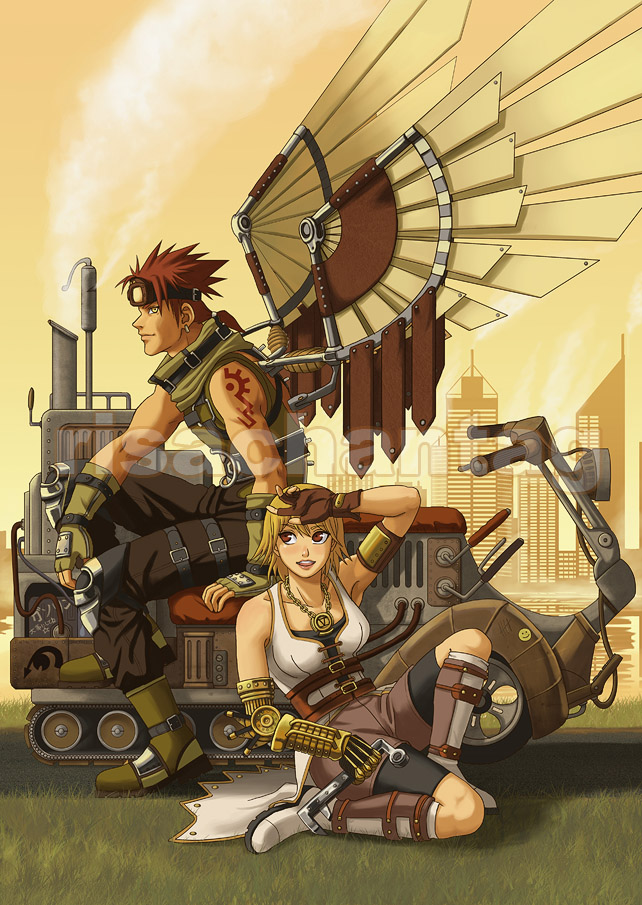 "Steampunk is a sub-genre of science fiction that typically features steam-powered machinery,especially in a setting inspired by industrialized Western civilization during the 19th century. "
Now, that is what Wikipedia defines it as but we're not skimming through web pages here.
Steampunk, in essence, can be many things, but generally speaking it is (currently, at least) a movement: taking the ideas of the Victorian era of the past and working it into today's world and lifestyle. Really, Steampunk can be seen as more of an aesthetic that can be applied to everything mostly, but the ideas behind it stem from the Victorian time.
That's not to say everything has to be from this time in history but generally what is created needs to follow something relating to that time in the past, and not specifically England. There are Steampunk characters in literature based in the garb of China, India, the American West, etc. It just has to be in the same general time span as Victorian England, so corsets and petticoats arent a necessity.
And no, just because you add goggles and gears to something does not make it Steampunk. Only add them to a character if it makes sense for them to be wearing them. An aristocrat with a fine lady on his arm in a mansion would have little use for them, unlike a mechanic or airship pirate.
So strap on your gloves, ready your giant automatons with their lazer-eyes, and get prepared: it's time to delve into the world of steam, cogs and imagination.
(This will more then likely be spread out over several blog posts, so stay tuned for more steam-powered shenanigans!)
- - - - -
A lesson in history then, comes with Steampunk. (Do not fret, I am not aiming to bore the reader!)
Most Steampunks will define the genre as being set in the Victorian era, the time that Queen Victoria ruled over most of the world, as we know it today with colonies set up in basically every corner of the world.

Surprisingly, the United States does not fall under the Queen's ruling.
The Victorian era is classified as a time of rapid change: the arts, ideas and ways of thinking as well as technology which ends up being a large part of the Steampunk subculture. The colony concept comes about with a little practice known as Imperialism. Merriam-Webster’s online dictionary defines imperialism as:
“The policy, practice, or advocacy of extending the power and dominion of a nation especially by direct territorial acquisitions or by gaining indirect control over the political or economic life of other areas; broadly: the extension or imposition of power, authority, or influence”
Which, judging by the above map, one can see just how extensive the practice was.

Meanwhile, in good old England, they were profitting from the colonizing of other countries. The Industrial Revolution had begun, with farmers moving into large cities for factory work. The colonization had given the British a surplus of materials to use in their factories, but the health and condition of those in the cities greatly diminished, with outbreaks of cholera and typhus. The cities were overcrowded and overpopulated, which resulted in many cases of sickness due to the cramping of the areas.
- - - -
Next Time, on Fantasy Found:
The Origins of Modern-Day Steampunk, and it's Place in Literature!

No comments:
Post a Comment